Book Review: Red State Mars
Travis J. I. Corcoran is known for writing award winning, hard science fiction with autistic levels of precise, technical details which lead one to believe that one could, with sufficient determination, recreate the fantastic worlds in which his stories take place (he has also published equally autistic homesteading books that can literally be used to transform the world around you). So, how does his latest release, Red State Mars, compare to his existing works?
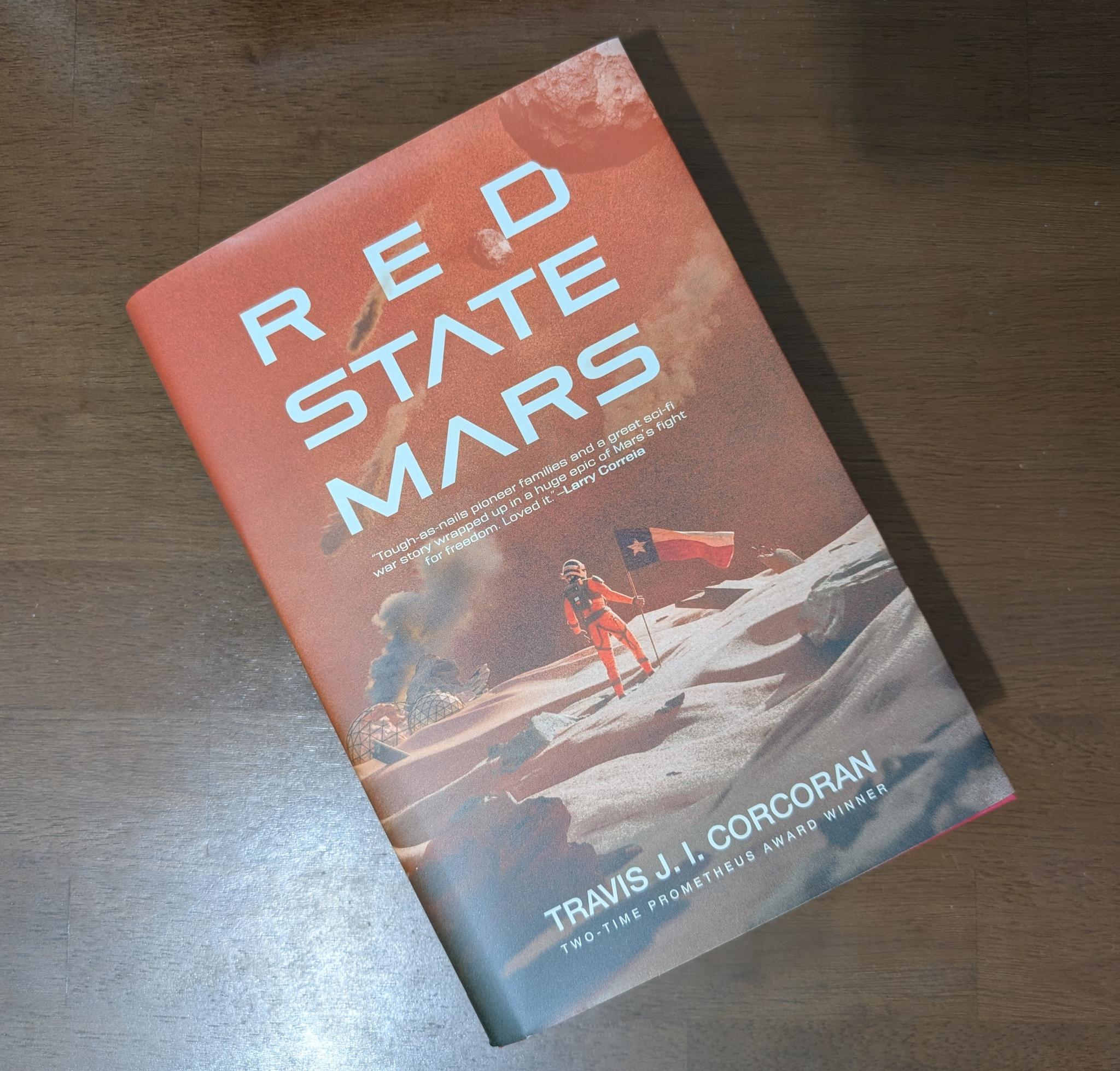
tl;dr: it’s not as autistic as his previous works, but still curiously autistic. An Aspergers version of his Aristillus series, if you will.
A Common Theme
In a recent Joe Rogan podcast, Chamath Palihapitiya mused about the technologies developed by Elon Musk and how close they are to enabling colonization of Mars. He asks, rhetorically:
What happens if he […] gets there first? Is he just allowed to […] do whatever he wants because it’s just kind of like a free for all. Like, it’s his constitution. Like, is that what happens?
This is more or less the common theme in Corcoran’s oeuvre: what happens when enterprising individuals, for various reasons, decide to exit the system by striking out across the solar system? Do they simply get to do what they want?
In Red State Mars, like in the Aristillus series, the answer is clearly: no, they do not. At least, not without a fight.
Aristillus For Normies
The afterword in Red State Mars really captures the delta between the Aristillus series and Red State Mars when describing the first email Ark Press sent to Corcoran:
I read The Powers of the Earth and liked it quite a bit…I understand and appreciate gritty realistic science fiction storytelling […] I would really like a Corcoran novel proposal (but less anarchocapitalistic, and more “American”)
That is precisely what Corcoran has delivered: a novel that will feel familiar to his fans, while having a broader appeal than his previous works.
Still Curiously Autistic
While Red State Mars clearly does more hand-waving when discussing the technologies in the story, there is still sufficient blueprints-as-literature for the more technically oriented to enjoy. For example, in typical Corcoran fashion, you will find that the topography, hydrology, etc. of Mars have been thoroughly researched and incorporated into the story.
In the afterword, Corcoran, in a seemingly apologetic tone, describes why some things in story wouldn’t actually work as described, though 99% of the readers will neither notice nor understand the explanation.
A More Mature Work
Along with the broader appeal, the story itself seems to actually be of a higher quality than previous works. Having written multiple, massive novels at this point, it should not be surprising that the work reads more as a novel than an explication of a political ideology dressed in a novel.
When reading the Aristillus series, it’s hard to not see Mike Martin as a type of self-insert of Corcoran. Many other characters like John and even some of the dogs could be seen as channeling the author through different filters, and there is considerable exposition in the dialogue.
This works well for the Aristillus series, since it is a society which formed in a manner that likely would consist of a lot of people who walk around ranting about political and economic theory, but it still results in a lack of depth for characters who are not anarchocapitalist (or, at least, anarchocapitalist adjacent).
In Red State Mars, though, none of the characters seem to be channeling Corcoran, though their actions, in aggregate, are clearly demonstrating many of the same political and economical themes. This makes the novel feel less like a cool story that the based autist on the internet wrote and more like the product of a real novelist™ who happens to be a based autist.
(Note that this is not at all a criticism of Corcoran’s pervious works, as they are still superior to most science fiction produced. I personally still prefer the cool story that the based autist on the internet wrote.)
What You’ll Find On Mars
So what is this story about?
Basically, American and Chinese expats who have struck out on their own and are living peacefully in various high tech biodomes until Chicoms increasingly assert their claims to the Chinese biodomes and, more generally, Mars itself.
The Americans must figure out how to resolve their own internal conflicts (how do you even start to deal with space rednecks!) so that they can successfully defend their claim. This leads to a tension between a desire for independence and the need to hitch their wagon to the United States, which they had abandoned.
Unlike the Aristillus series which describes a slow building conflict as parties from Earth slowly assemble the necessary technology to attack the settlers on the moon, the fact that there are already established Chinese biodomes on Mars means that the conflict facing the Americans picks up quickly with a force outnumbering their own. This requires the Americans to counter with ingenuity more so than with force (though they eventually bring overwhelming force into play as well).
Should You Read It
If you are a fan of the Aristillus series, then you will be slightly disappointed this isn’t Aristillus 3, but you’ll still be happy that you have a new Corcoran novel to read. More generally, any fan of hard science fiction with even remotely libertarian leaning beliefs will appreciate a high quality novel that is not poisoned with modern day identity politics, etc.